Baumkuchen: A Festive Layered Cake Made Under the Grill

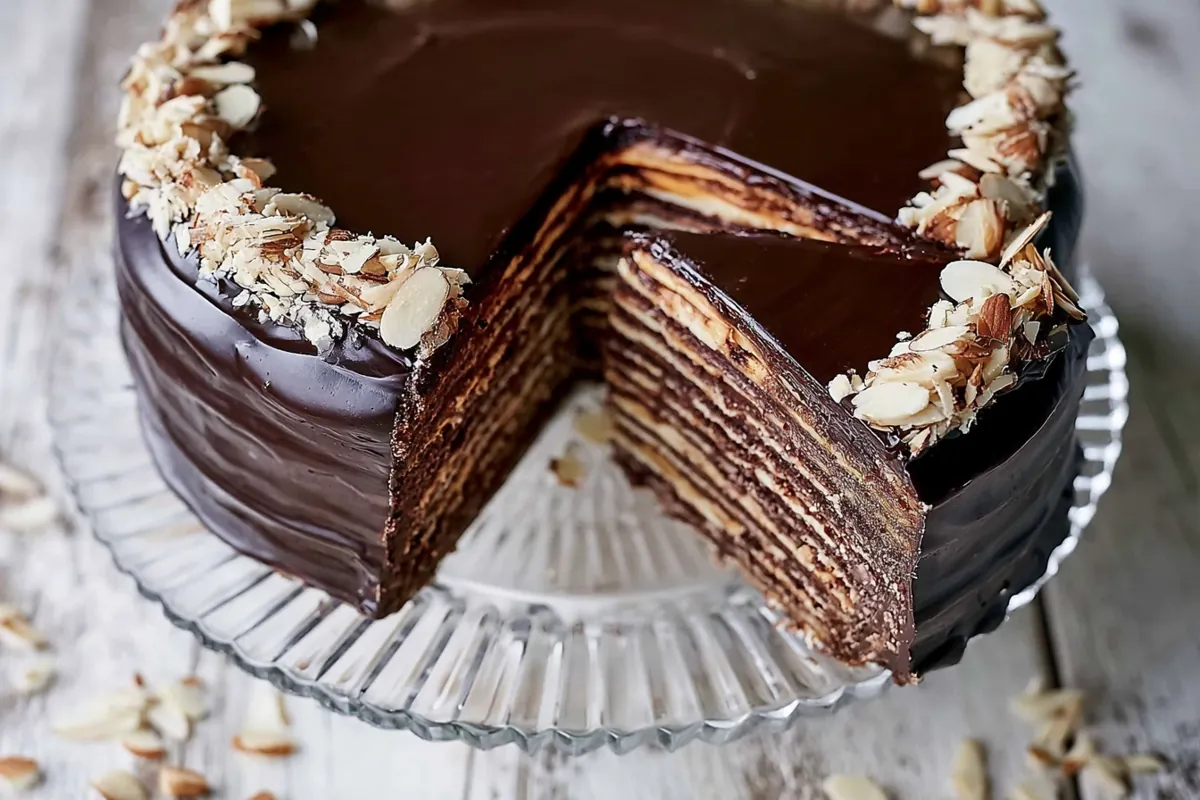
Baumkuchen looks as though it needs specialist equipment, yet this version builds those distinctive rings beneath an ordinary kitchen grill. Each thin layer cooks until lightly browned before the next is added, creating striped slices with a soft marzipan crumb.
The process takes patience, though none of the individual steps is difficult. Orange, marmalade, dark chocolate, and toasted almonds give this Baumkuchen a rich finish suited to holidays and family gatherings.
Baumkuchen’s European Origins and Tree-Ring Tradition
The name Baumkuchen translates from German as “tree cake.” Cut through the finished cake and the reason becomes clear: the alternating pale and browned layers resemble the growth rings inside a tree trunk.
Traditional versions are made by brushing batter onto a rotating spit positioned near a heat source. One coat cooks, another is added, and the cycle continues until the cake has many fine rings. It’s a striking technique, though it isn’t practical in most home kitchens.
This recipe keeps the same principle and changes the equipment. Instead of rotating the batter, you spread it across the base of a 23cm springform tin and grill each layer separately. The cake remains flat rather than cylindrical, but the sliced pattern still captures the character of the original. Thin layers matter here. A heavy ladleful can bake like an ordinary sponge and hide the striped effect you’ve spent time creating.
How Karl and Elise Juchheim Brought Baumkuchen to Japan
Baumkuchen began as a European cake, yet it developed an especially strong following in Japan during the early twentieth century. German confectioner Karl Juchheim and his wife, Elise, became closely connected with that story after introducing the pastry to the Japanese public.
The cake’s appearance helped it stand apart. Those neat rings looked refined when sliced, and the baking process required enough care to make it feel appropriate for gifts and celebrations. Over time, Baumkuchen became available through specialist bakeries, department stores, and packaged confectionery ranges rather than remaining an unfamiliar European import.
Baumkuchen in Modern Japanese Culture
Modern versions come in different sizes and flavors, from small individual cakes to large rings intended for sharing. Some are coated with sugar or chocolate, while others keep the exterior plain so the layered crumb remains the focus.
Its ring pattern is also associated with longevity and the steady passage of time, which helps explain why Baumkuchen is often chosen for weddings and other important occasions. A home-grilled version won’t have the exact shape produced on a spit, but the idea is the same: one layer after another, each given time to set before the next begins.
When you slice this cake, look for clearly separated golden lines. They don’t need to be mathematically even. Slight differences make it look handmade, which it is.
About This Home-Grilled Baumkuchen Recipe
Marzipan gives the batter a dense, tender texture and a clear almond flavor. It needs to be beaten first with a little of the 100ml single cream, otherwise firm pieces can remain in the mixture. Add the rest of the cream gradually until the paste becomes pale and smooth, then work in 170g butter and the sugar.
Ten separated eggs provide structure without making the cake heavy. The yolks enrich the batter, while the whites are whisked to firm peaks and folded in near the end. Use a large metal spoon and turn the mixture rather than stirring it in circles. A few faint streaks of egg white are safer than vigorous mixing that knocks out the air.
Orange zest cuts through the sweetness, and the thin layers of marmalade add small bursts of sharpness through the cake. The finished coating brings in dark chocolate and spiced rum, with toasted almonds scattered over the top for a little crunch. It’s rich, so narrow slices are usually enough.
Top Tips for Building Thin, Even Baumkuchen Layers
Set the grill to medium-high before mixing the batter, and position the rack so the top of the cake sits close enough to color without scorching. Grills vary a lot. Watch the first layer carefully rather than treating four minutes as an exact promise.
Spoon in only enough batter to cover the base of the tin. About two-thirds of a ladle is a useful starting point, though the amount depends on the size of your ladle. Spread it right to the edges with a pastry brush. You’re aiming for a thin film, not a sponge-cake layer.
Cook each one for roughly 4 minutes, until the surface is set and evenly golden. Pale patches usually mean the batter wasn’t spread evenly. Very dark edges suggest the tin is too close to the heat. Adjust the rack before adding more batter; lowering the grill temperature halfway through can make the later layers cook too slowly.
Brush softened marmalade over every second or third layer. Keep it thin. Too much can make the next coat of batter slide and may leave sticky gaps when the cake is cut.
Continue until you have around 15 to 18 layers. The repetition is the work here. Once finished, brush the top generously with marmalade, loosen the edge with a knife, and let the cake cool before chilling it for several hours or overnight. Chilling firms the rings and makes the cake easier to remove, coat, and slice cleanly.
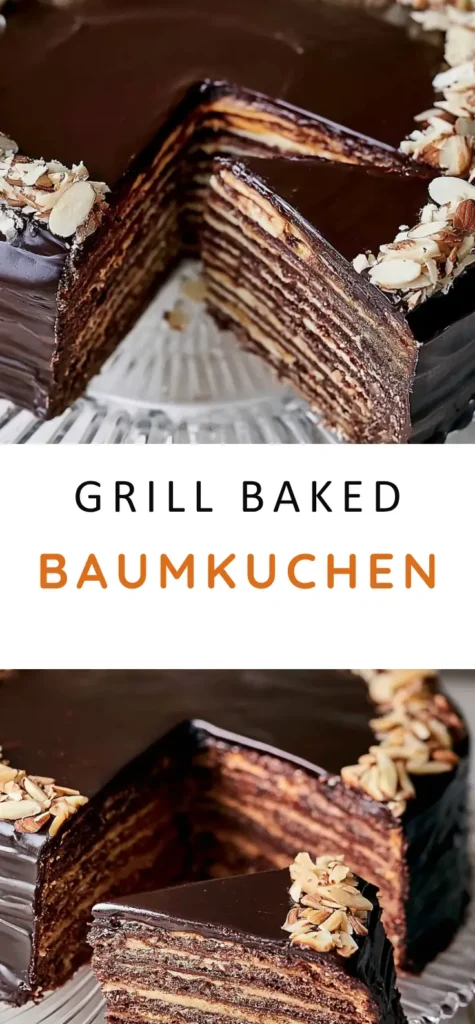
A Festive Cake Worth the Layers
Baumkuchen asks for patience more than advanced skill. Keep each layer thin, watch the grill closely, and give the chilled cake time to firm before adding the glossy chocolate-rum coating.
Serve it in narrow slices with tea or festive sherry. The marzipan crumb, orange zest, marmalade, and toasted almonds make every slice feel generous without needing a large portion.
Baumkuchen
Ingredients
Equipment
Method
- Preheat the grill to medium-high, grease a 23cm springform cake tin, and line the base with parchment paper.
- Place the chopped marzipan and a small amount of the cream in the bowl of a stand mixer fitted with the paddle attachment, then beat until a thick paste forms.
- Gradually add the remaining cream and continue beating until the marzipan mixture becomes pale and smooth.
- Add 170g of the softened butter and beat until fully incorporated, then add the sugar and continue beating until pale and creamy.
- Beat in the egg yolks one at a time, reserving the whites, then mix in the vanilla extract and finely grated orange zest.
- Sift the self-raising flour and cornflour into a separate bowl, mix them together, and gradually fold them into the batter with a large metal spoon.
- Whisk the reserved egg whites to firm peaks, then gently fold them into the batter without knocking out too much air.
- Place the marmalade in a small saucepan and warm it over low heat until softened, adding a small splash of water if needed to make it easy to brush.
- Spoon about two-thirds of a ladle of batter into the prepared tin and use a pastry brush to spread it into a very thin, even layer covering the base.
- Place the tin under the grill for about 4 minutes, watching closely, until the first layer is set and evenly golden.
- Spread another thin layer of batter over the cooked surface and grill it until golden, then brush on a thin coating of softened marmalade after every second or third layer.
- Continue layering, grilling, and occasionally glazing until all the batter has been used and the cake has approximately 15 to 18 layers.
- Brush the top generously with marmalade, run a knife around the edge of the cake, and allow it to cool completely in the tin.
- Cover the cooled cake and refrigerate it for at least 4 hours or overnight so the layers firm up before glazing.
- A couple of hours before serving, melt the dark chocolate and remaining 50g butter in a heatproof bowl set over a saucepan of gently simmering water.
- When the chocolate mixture is completely melted and glossy, stir in the spiced rum and leave the glaze to cool for 10 minutes.
- Remove the chilled cake from the tin, place it on a serving plate, and spread the chocolate glaze evenly over the top, allowing it to drip naturally down the sides.
- Let the glaze set slightly, scatter the toasted flaked almonds over the top, and leave the cake to cool completely before slicing and serving.
Notes
- Grills vary in strength, so watch the first layer closely and adjust the distance from the heat if the edges darken before the center.
- Use only enough batter to cover the surface in a thin film; thick layers will reduce the distinctive tree-ring effect.
- Keep each marmalade coating light so the next batter layer does not slide or separate.
- Chilling the cake for several hours makes it easier to remove from the tin, glaze, and cut into clean slices.
- Store the finished Baumkuchen in an airtight tin at room temperature for up to 2 days.